Are you spending more on Google Ads but getting fewer results? Your ad budget or targeting might not be the main issue here. In many cases, the problem comes down to your quality score, a key performance indicator that most advertisers don’t pay enough attention to.
Your Google Ads quality score is a 1 to 10 rating that measures how relevant your ads, keywords, and landing pages are to the person searching. A high-quality score in Google Ads means lower costs, a stronger ad rank, and better ad placements. But a low one can slowly drain your ad spend.
That’s why important quality score conversations show up in campaign performance reviews. In this article, we’ll break down the important Google Ads quality score factors and show you how to improve performance.
Let’s start with the basics of Quality Score and how it works.
What Is Google Ads Quality Score and How It Works
Quality score in Google Ads is the metric that decides how far your ad budget actually goes. It works as a diagnostic tool for your campaigns. Here’s how it works so you can make smarter decisions about your advertising campaigns.
What Is Google Ads Quality Score?
In simple terms, Google Ads quality score is a rating between 1 and 10 that Google gives each of your keywords. This way, it tells you how relevant and useful your ad is to someone searching for that term.
Here, a score of 7 or above is generally considered strong, while anything below 5 usually means there are gaps in relevance or performance that need attention. The higher your score gets, the more Google finds your ad quality to be worth showing to people.
Google Ads Quality Score
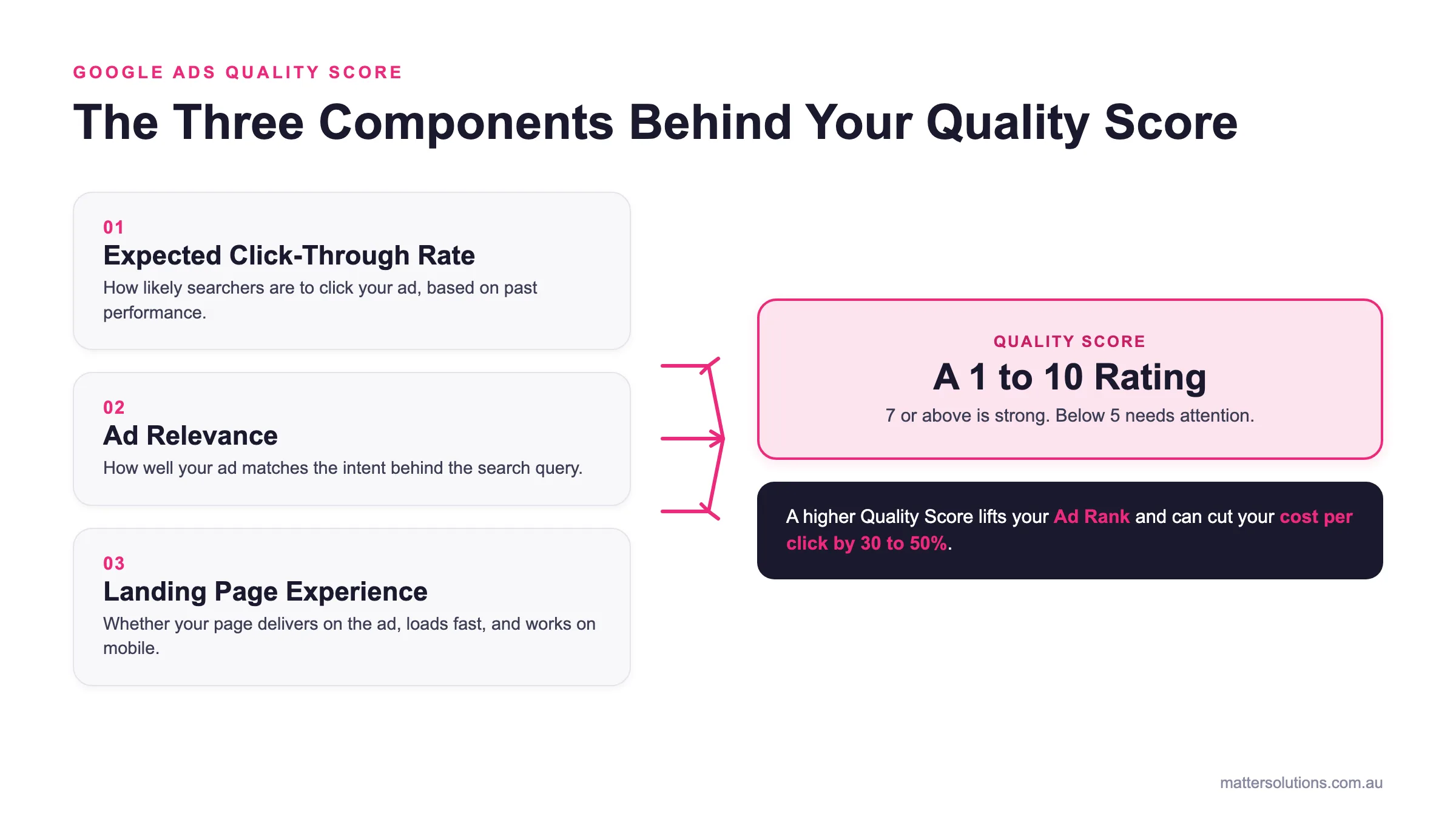
The Three Components Behind Your Quality Score
Expected Click-Through Rate
How likely searchers are to click your ad, based on past performance.
Ad Relevance
How well your ad matches the intent behind the search query.
Landing Page Experience
Whether your page delivers on the ad, loads fast, and works on mobile.
Quality Score
A 1 to 10 Rating
7 or above is strong. Below 5 needs attention.
A higher Quality Score lifts your Ad Rank and can cut your cost per click by 30 to 50%.
The three components Google combines into your Quality Score, and how a stronger score lifts ad rank and lowers cost per click.
Three Key Components Behind Ad Quality Score
Every quality score comes down to three key components, and each one has a direct impact on how your ad performs. This is what they measure and where you should focus your effort:
Expected Click Through Rate (CTR)
This is Google’s prediction of how likely someone is to click your ad when it shows up. It uses past performance data for that keyword. That’s why building a strong expected CTR over time signals to Google that your ad genuinely connects with searchers.
Ad Relevance
While CTR looks at clicks, ad relevance focuses on intent. This means it checks how well your ad matches what the user is actually searching for. For example, if someone searches “emergency plumber Brisbane” but your ad is about general home renovations, Google sees it as a mismatch.
So, improving ad relevance means making your ad copy more specific and closely aligned with the search query.
Landing Page Experience
Landing page experience checks whether your landing page actually delivers on the ad’s promise. Your page load speed is the most important factor here (ideally under 3 seconds). Mobile-friendly design, useful content, and relevance and landing page layout are valuable as well.
For example, if someone clicks expecting a pricing page but lands on a general homepage, that mismatch can lower your score.
As you can tell, the score isn’t locked in. It changes as Google gathers new data and updates its predictions. Because of this, what performs well today may still need adjustments later.
| Component | What Google looks at | How to improve it |
|---|---|---|
| Expected click-through rate | How likely someone is to click your ad, predicted from past performance for that keyword. | Write compelling ad copy with your main keyword in the headline, add responsive search ads, and use ad assets like sitelinks and callouts. |
| Ad relevance | How well your ad matches the intent behind what the user actually searched for. | Build tightly themed ad groups, align copy to the search query, and add negative keywords to block irrelevant searches. |
| Landing page experience | Whether your page delivers on the ad’s promise, loads quickly, and works well on mobile. | Match the headline to the ad’s offer, add a clear call to action, keep load time under 3 seconds, and use a mobile-friendly design. |
Why Quality Score in Google Ads Is a Key Performance Indicator
This metric affects your ad rank, which decides where your ad shows, and it also influences your cost per click.
In fact, ads with a quality score of 7 or higher usually see 30 to 50% lower cost per click compared to average. This means that as your Quality Score improves, you can pay less per click while still getting strong placement. So, a higher score helps you both save money and stay visible.
On the flip side, a low score increases your costs just to maintain visibility. This makes it harder to compete, even if you have a strong budget, as advertisers with better scores get more efficient results.
Now that you understand how it works, let’s look at the actual factors you can control.
Google Ads Quality Score Factors That Impact Your Campaigns (Beyond the Basics)
Most advertisers already know about the three core components behind ad quality score. But those aren’t the only things Google looks at when deciding how your ads perform. These supporting Google Ads quality score factors often fly under the radar, yet they can have a strong impact on how your Google Ads campaigns deliver.
1. Account Structure and Ad Groups
Tightly themed ad groups help Google understand what each ad is about and match it with the right audience. This could be grouping keywords like “roof repair Sydney,” “emergency roof repair Sydney,” and “roof leak fix Sydney” together.
However, if you mix unrelated keywords in one ad group, it weakens your message and lowers relevance. The better approach is to split keywords into focused ad groups, which sends much stronger signals to Google.
For example, one ad group can target “roof repair Sydney” and related terms that match general repair searches. And another focuses only on urgent searches like “roof leak emergency Sydney.”
2. Keyword Strategy and Search Term Alignment
Choosing relevant keywords that closely match the user’s search query is the first step, but it is not enough on its own. You also need to pair them with the right keyword match types to control which searches trigger your ads without blowing your budget.
This means using broad match for wider searches like “roof repair near me”. Or phrase match for when the keyword appears in order, like “roof repair Sydney services,” and exact match for very specific searches like “roof repair Sydney.”
3. Compelling Ad Copy and Messaging
The way you write ad copy has a direct effect on ad relevance. So each ad variation should speak to a specific intent with primary keywords sitting naturally in the headline or description. We recommend testing different ad variations to help you figure out what works best.
Remember to also keep your messaging consistent with your landing page content to create a smooth, connected user experience.
4. Use of Ad Extensions
Ad extensions give your listing more space on the page, which naturally lifts your click-through rate and can push you toward a higher ad position. They also add extra details like sitelinks, callouts, and structured snippets that help searchers decide whether to click. And Google tends to reward that extra effort by improving your ad rank and lowering your cost per click.
5. Historical Performance and Account Health
Your click-through rate CTR history and overall campaign performance in your Google Ads account influence how Google predicts your future results. This means if your account shows steady improvement over time, it’ll signal to Google’s system that your campaigns are well-optimised. As a result, well-managed accounts often earn better performance scores.
6. Device and User Experience Signals
Finally, how your ads and landing pages perform on mobile devices can influence your score. Because a landing page experience that works fine on desktop but loads slowly on a phone creates a poor user experience, and Google notices this. But faster load times and a clean, mobile-friendly design can keep people engaged instead of leaving the page.
So, don’t stop at the three core components. These supporting factors are what actually drive quality score improvements at scale.
Google Ads: How to Improve Quality Score (Step-by-Step Optimisation Guide)
If you want to improve your quality score in Google Ads, you need to align your ads, keywords, and landing pages together. Below is a step-by-step breakdown of what to focus on.
Step 1: Improve Your Expected Click Through Rate
As we touched on earlier, your expected click-through rate is Google’s guess at how likely someone is to click your ad. One of the best ways to lift it is by writing compelling ad copy that puts your main keywords right in the headline and gives people a reason to click. This could be offering something valuable like same-day service, free quotes, or 24/7 support.
From there, you can add responsive search ads since they let Google test different headline and description combinations to find what performs best.
You can take it a step further by adding ad assets like sitelinks and callouts, which are extra elements that appear with your ad in Google search results. This will make your listing bigger on the page (and naturally draw more attention). And because performance can change over time, we advise continuously testing new ad variations so your ads stay fresh and continue performing well over time.
Step 2: Improve Ad Relevance
Improving ad relevance means reducing the gap between what someone searches and what your ad says. A good starting point is building tightly themed ad groups around a small set of related keywords (which we mentioned earlier).
It’s also worth regularly checking your search term reports to see what people actually typed before clicking your ads. You can then add negative keywords, which are terms you don’t want your ads to show for, like “free” or unrelated services. It’ll block irrelevant searches so you stop paying for clicks that were unlikely to convert.
So the tighter the connection between the user’s search intent and your messaging, the more Google rewards you with a stronger relevance score. If you get this right, it can set up your ad relevance and landing page alignment nicely for the next step.
Step 3: Improve Landing Page Experience
Your landing page experience continues from your ad. By now, you know why relevance and landing page alignment are important, so this step is about execution.
Start with your headline. It should reflect the same offer or service that your ad mentions, so there’s no disconnect when someone clicks through. From there, make sure your call to action is easy to spot and tells people exactly what to do next.
Speed is another key factor, since pages that load in under 3 seconds see significantly lower bounce rates. And with mobile devices now accounting for the majority of searches, a slow phone experience can undo everything your ads and landing pages are working toward.
Step 4: Refine Your Campaign Structure
If you’re running the same ad across a bunch of unrelated keywords, Google has a harder time figuring out what’s actually relevant to each search. A better approach is to split your campaigns based on search intent.
Branded terms like your company name should go into their own campaign with lower bids and a landing page. On the other hand, high-intent service terms like “roof repair Sydney” or “emergency plumber near me” deserve a separate campaign. These also convert at a higher rate, so pair them with stronger bids and dedicated service pages.
This separation and keyword selection lead to better ad positions and stronger results across the board.
Step 5: Monitor and Adjust Regularly
None of this is a set-and-forget situation, which is why regular check-ins are important.
Start by opening your Google Ads dashboard and using the Quality Score column to find quality score data for each keyword. It works as a diagnostic tool that shows what is performing well and what needs attention. Next, review your search term reports to find wasted spend and new keyword opportunities. You should also regularly test different parts of your campaigns.
The small, steady changes you’ll notice might not feel dramatic in the moment, but they’ll lead to quality score improvements over time.
How Quality Score Improvements Affect Ad Spend and Performance
Quality score improvements can have an effect on how much you spend, where your ads appear, and how well your Google Ads campaigns actually perform. Let’s break down how each part connects.
How Ad Quality Score Impacts Ad Spend
Put simply, a higher ad quality score means you pay less for every click. That’s because Google’s ad auction is designed to reward advertisers who create relevant, useful ads. And it does this by charging them a lower cost per click compared to those with weaker scores.
So rather than throwing more money at the problem, a good quality score helps you stretch your ad budget further by cutting out wasted spend.
Impact on Ad Rank and Ad Position
Your quality score also feeds directly into your ad rank, which is the formula Google uses to decide where your ad appears on the page. When your score is strong, you end up with these benefits:
- Better Ad Placements: A higher score pushes your ads into more visible spots across search results, which naturally puts you in front of more potential customers.
- Higher Ad Position at Lower Cost: Rather than trying to outbid everyone else, you can earn a higher ad position simply by having a more relevant ad. You can also support it with a stronger landing page behind it.
- Competitive Edge: Even advertisers with bigger budgets can miss out on better ad placements if their quality scores aren’t up to scratch. This means a well-optimised account can still compete with and outperform higher-spending advertisers in ad position and cost efficiency.
So, the takeaway here is that once you improve your quality score, you’re getting more visibility for less money. That’s a win regardless of what size your budget is.
Performance Gains from a High Quality Score
Beyond saving money and earning stronger ad placements, a high Quality Score improves overall campaign performance over time. These benefits build on each other, which is why it is important to keep improving and not treat it as a one-time fix. This is what we mean:
- More Traffic: Better visibility naturally leads to more clicks, and that brings more traffic to your site without you needing to increase your advertising spend.
- Stronger Campaign Performance: Those extra clicks also send positive signals back to Google. Then a higher click-through rate paired with stronger relevance tells the algorithm your ads deserve priority, which lifts performance across your whole account over time.
- Improved Conversion Potential: Perhaps the most important shift, though, is in who’s actually clicking. When your score in Google Ads is strong, the people landing on your page tend to be a much better match for what you’re offering. This means you’re getting traffic that’s more likely to take action.
This way, a high-quality score brings in the right people and this is where you start to see stronger results in your overall performance and returns.
Quality Score Starts with Relevance: Here’s Your Next Step
So, did this clear things up about your quality score in Google Ads? If there is one thing worth remembering, it is that all Google Ads Quality Score factors come back to one idea. That idea is making sure your ad copy, relevant keywords, and landing pages all pull in the same direction.
When your ad relevance and landing page experience line up with what people are actually searching for, you earn a high Quality Score. This leads to lower cost clicks and better overall performance.
However, that kind of relevance and landing page consistency takes ongoing effort. So keep testing and refining your ads instead of leaving them as they are.
Need a hand? Our Matter Solutions team can help you improve your quality score and get your Google Ads campaigns working harder.
Frequently Asked Questions
Here are some of the most common questions people ask about quality score in Google Ads.
How Do I Find My Quality Score In Google Ads?
You can find your quality score by adding the quality score column to your keyword view inside your Google Ads account. This shows your ad quality score at the keyword level, so you can see exactly which keywords are performing well and which ones need work. It’s one of the quickest ways to check your score in Google Ads without digging through multiple reports.
Does Quality Score Affect Ad Rank And Ad Position?
Yes, your ad quality feeds directly into the ad auction formula alongside your bid amount, which together determine your ad rank and ad position. A stronger score means you can compete for top spots without needing to outspend everyone else.
How Often Should I Optimise My Google Ads Campaigns?
There’s no set schedule, but checking in weekly or fortnightly is a good habit. Focus on testing your ad copy and reviewing your landing page performance. Then update ad relevance and landing page alignment as your campaigns evolve. This consistent effort will improve your quality score over the long run. Also, your ads and landing pages should always reflect what your audience is searching for.
Need help with your digital marketing?
Book a free strategy call and let's discuss your goals.
Book a Strategy Call