LinkedIn reaches billions of professionals, including Fortune 500 CEOs. Yet most businesses still pour their ad spend straight into Google Ads without stopping to ask who their buyer actually is.
Both platforms sit under the digital marketing umbrella, but they work very differently. If you pick the wrong one for your audience, you’ll burn through budget without much to show for it.
At Matter Solutions, we’ve helped Australian businesses get more from their paid advertising by choosing the right platform for the right goal. This guide breaks down Google Ads vs LinkedIn Ads across formats, targeting, cost, and lead generation so you can make a smarter call.
| Factor | Google Ads | LinkedIn Ads |
|---|---|---|
| Audience and intent | Intent: reaches people actively searching for what you sell | Identity: reaches people based on who they are professionally |
| Targeting | Keywords and search volume; no view of the searcher’s seniority | Job title, seniority, industry, company size and company name |
| Cost model (AUD) | Pay-per-click, roughly $1 to $5 CPC; flexible, low entry point | Pay-per-click, roughly $8 to $15 CPC; higher minimum, premium price |
| Funnel fit | Bottom of funnel, capturing demand that already exists | Longer B2B sales cycle, staying visible across weeks or months |
| Best for | Local business, B2C, high-volume search campaigns | B2B, account-based marketing, reaching decision makers |
| When to choose it | Buyers are searching now and you want lower cost per click | You sell to specific industries or roles and lead quality matters most |
Google Ads vs LinkedIn Ads: What’s the Real Difference?
Google Ads targets people actively searching for something. On the other hand, LinkedIn Ads targets people based on who they are professionally.
LinkedIn is different here because, instead of waiting for someone to search, it finds them based on their job title, industry, or company. Basically, both of them run on a pay-per-click model, but the mindset behind each click is worlds apart.
When you put Google Ads vs LinkedIn side by side, it really comes down to intent versus identity. Google catches people mid-search, right when they need something. But LinkedIn gets your ad in front of the right person based on who they are, not what they just typed.
For Australian businesses, that difference shapes how your entire ad spend should be split across both platforms.
Google Ads vs LinkedIn Ads
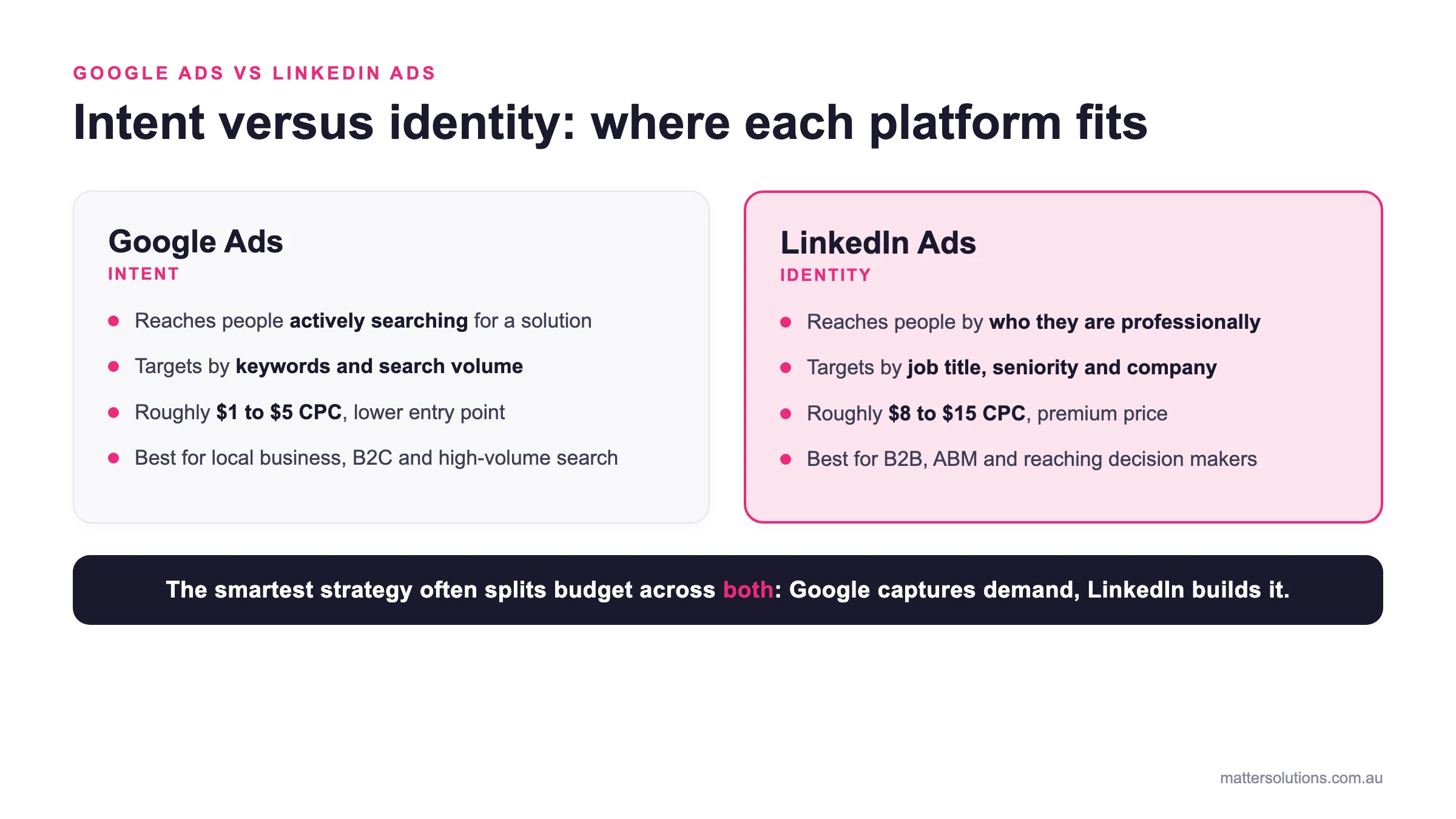
Intent versus identity: where each platform fits
Google Ads
Intent
- Reaches people actively searching for a solution
- Targets by keywords and search volume
- Roughly $1 to $5 CPC, lower entry point
- Best for local business, B2C and high-volume search
LinkedIn Ads
Identity
- Reaches people by who they are professionally
- Targets by job title, seniority and company
- Roughly $8 to $15 CPC, premium price
- Best for B2B, ABM and reaching decision makers
The smartest strategy often splits budget across both: Google captures demand, LinkedIn builds it.
Google Ads captures existing demand through intent, while LinkedIn Ads reaches buyers by professional identity.
Ad Formats Compared: What Each Platform Actually Offers
Between search ads, display, video, sponsored content, and message ads, both platforms offer more ad formats than most businesses ever use. Here’s a quick look at what each one brings to the table.
Google Ads Formats at a Glance
Google’s ad formats cover a lot of ground. Search ads show up directly on the search engine results page when someone types in a relevant query.
Shopping ads and video ads round out the mix for product and awareness plays. On top of that, Google Display Network placements extend your reach across millions of websites, and Performance Max campaigns pull all of these together under one campaign.
LinkedIn Ad Formats Worth Knowing
LinkedIn’s ad formats are built around professional context. Sponsored content sits natively in the feed, so it blends in rather than interrupting the scroll. Also, single-image ads and carousel ads keep things visual, and because of that, they tend to get more engagement than sidebar placements.
That said, not every format is about grabbing attention. Dynamic ads personalise the creative automatically using profile data, while text ads sit in the sidebar for a lower-cost, quieter reach. The standout format, though, is lead gen forms, because they remove the manual form-filling entirely.
Unlike a standard ad that sends someone to a landing page, gen forms auto-fill using the user’s LinkedIn profile, which cuts out a lot of friction.
Reaching Decision Makers: Which Platform Does It Better?
Both platforms reach decision makers, but they do it in very different ways. LinkedIn zeroes in on job title, seniority, and industry. In contrast, Google catches them the moment they are actively searching for a solution.
LinkedIn’s targeting is what sets it apart here. You can filter by job title, company size, seniority level, and industry all at once, which means your ads land in front of precisely the right people. From our experience working with B2B clients, this level of precise targeting is hard to replicate on any other platform.
Google, on the other hand, relies on keywords and search volume to find your target audience. It doesn’t know if the person clicking is a junior intern or a senior buyer. That’s a real gap when your product is only relevant to specific decision makers in the B2B buyer journey, and you need to target people with real purchasing authority.
The Buyer Journey and Where Each Platform Fits
Once you know where each platform sits in the buyer journey, you stop paying for clicks that were never going to convert. So, in this section, we’ll explore exactly how they each line up.
Google Ads and Bottom-of-Funnel Intent
Google Ads works best at the bottom of the funnel. People actively searching for a solution are already close to a decision, which is why search campaigns on Google tend to convert well. A query like “hire SEO agency Brisbane” on the search engine results page tells you the person is ready to act, not just browsing.
Worth noting, intent-based targeting is Google’s core strength. Paid search, at its core, chases demand that already exists rather than building it from scratch. If someone is looking for what you sell, Google Ads works to get you in front of them first.
LinkedIn Ads and the Longer B2B Sales Cycle
LinkedIn Ads suit a longer sales cycle. B2B purchases rarely happen after one ad. And they usually involve several people across a business before anyone signs off.
What LinkedIn does well is keep your brand visible throughout that whole process. Sponsored content and message ads reach the same professionals repeatedly, across weeks or even months, which is exactly what a drawn-out sales cycle calls for.
Account-Based Marketing: Does LinkedIn Win Here?
For account-based marketing, LinkedIn is a strong fit. So, what makes it work so well? First of all, it lets you target by company name directly. Then, you can layer on job title and seniority to reach the exact people inside that account.
Unlike Google Ads, LinkedIn campaigns let you upload a list of target companies and serve ads specifically to people who work there. Google simply can’t match that level of control at the company level.
In fact, 84% of businesses using ABM report higher ROI than other marketing approaches. That means LinkedIn has become the natural home for businesses running account-focused campaigns.
Google can support ABM through customer match lists, which let you target users based on email addresses. That said, you cannot target by company name the way LinkedIn allows. For business decision makers running a focused marketing strategy, that makes Google ads a more indirect route for ABM.
Conversion Tracking on Both Platforms
How do you know which platform is actually driving results if your tracking is not set up correctly on both? Here’s what you need to know about each one.
- Google Ads Conversion Tracking: Google’s conversion tracking connects directly with Google Analytics, meaning calls, form fills, and purchases all show up in one place. For marketing teams managing multiple campaigns, that level of visibility is genuinely useful.
- LinkedIn’s Insight Tag: LinkedIn uses an Insight Tag, placed on your site, to track what happens after someone clicks your ad. It works similarly to Meta’s pixel, and it feeds data back into your LinkedIn performance dashboard so you can see which ad creatives are doing the heavy lifting.
- Where Google Pulls Ahead: Both platforms support third-party tracking tools, but Google’s ecosystem runs deeper. It connects with Tag Manager, Google Analytics, and most major CRM platforms, which makes it easier to tie your landing pages and ad spend back to real revenue.
Frankly, neither platform will tell you much if your tracking is poorly set up. When you get the foundations right on both, you’ll start drawing conclusions that mean something.
Generate Leads with Google Ads or LinkedIn: Which Costs Less?
If you are chasing volume, Google Ads will likely cost less per click. Otherwise, LinkedIn Ads is the better fit if lead quality matters more than quantity. However, the final decision isn’t that simple because cost-per-lead tells a very different story than cost-per-click.
LinkedIn ads costs are noticeably higher, with CPCs regularly sitting between $8 and $15 in competitive B2B niches. You’ll get Google leads in less per click, say around $1 to $5 on average, but that doesn’t always mean cheaper per qualified lead. That means lead gen forms on LinkedIn are clearly the stronger pick for professional services businesses chasing quality over quantity.
Let’s check this quick comparison to understand how the two stack up on cost and use case.
| Google Ads | LinkedIn Ads | |
| Avg. CPC | $1–$5 | $8–$15 |
| Best for | Local business, B2C, search campaigns | B2B, gen forms, decision makers |
| Lead quality | Varies by industry | Generally higher for B2B |
| Ad spend control | Flexible, lower entry point | Higher minimum, premium price |
| Generate leads via | Search, display, shopping ads | Sponsored content, lead gen forms |
The bottom line is this: if you’re after volume and a lower entry cost, Google Ads is hard to beat. And in the case of B2B lead generation, LinkedIn’s higher upfront cost often makes more sense when you factor in the quality of who’s actually filling out your forms.
So, Which One Wins for Your Digital Marketing Goals?
Now that you know how each platform works, the answer comes down to one thing: who are you actually trying to reach?
For local businesses and B2C brands, Google Ads is usually the stronger starting point. People actively searching on Google Search are already interested, which means your ads vs LinkedIn ones will likely convert faster at a lower cost. If your buyers are out there searching for what you sell right now, Google is where you need to be.
On the flip side, if you’re selling to specific industries, job titles, or company sizes, LinkedIn is the better platform. In fact, for professional services brands running a longer sales cycle, a multi-platform strategy that splits the budget across both tends to deliver the best results.
Verdict: Google Ads and LinkedIn work better together than they do apart, and the smartest digital marketing strategies treat them that way.
Ready to Run Ads That Actually Bring in Business?
Most businesses jump straight into Google Ads or LinkedIn Ads without stopping to match the platform to their audience, their sales cycle, and their lead generation goals. Do that groundwork first, and your digital marketing budget starts going a lot further.
We’ve seen this play out time and again with Australian businesses. Frankly, the best return on ad spend doesn’t always come from the biggest budgets. More often than not, it comes from businesses that figured out where their buyers actually spend time online, then built their marketing strategy around that simple insight.
If you’re not sure which platform suits your business, or you want a second opinion on how your current campaigns are tracking, we’d love to help. Contact us at Matter Solutions for a straight-talking paid ads strategy session.
Frequently Asked Questions
Is Google Ads or LinkedIn Ads better for lead generation?
It depends on the type of leads you’re after. Google Ads tends to generate higher volumes at a lower cost per click, but LinkedIn Ads consistently delivers higher quality leads for B2B businesses. If you’re selling to other businesses, LinkedIn’s lead generation capabilities are hard to look past.
What is the main difference between Google Ads and LinkedIn Ads?
Google Ads vs LinkedIn really comes down to intent versus identity. Google Ads, formerly known as Google AdWords, targets people based on what they’re actively searching for.
LinkedIn Ads, on the other hand, targets people based on who they are, their job title, industry, and seniority. That means it’s a very versatile ad platform altogether.
Which platform is better for reaching a specific target audience?
LinkedIn wins here, and it’s not particularly close. LinkedIn’s targeting lets you filter by job title, company size, industry, and seniority, so your ads reach exactly the right people. Both Google Ads and LinkedIn have audience tools, but LinkedIn users are verified professionals, which makes the targeting far more reliable for B2B campaigns.
How much does it cost to advertise on Google Ads vs LinkedIn?
Google Ads vs LinkedIn is a pretty significant gap when it comes to cost. Google’s average CPC sits around $1 to $5 across most industries, while LinkedIn’s premium price point puts average CPCs between $8 and $15. That said, ads vs each other on cost alone misses the point, since LinkedIn’s higher ad spend often comes with stronger returns for B2B advertisers.
Can local businesses benefit from LinkedIn Ads?
Honestly, most local businesses will get better results from Google Ads. LinkedIn Ads suits a broader, professional audience, and the premium price point doesn’t always make sense for local business owners with tighter budgets. Google Ads, with its search volume and location targeting, is usually the smarter digital marketing starting point for local campaigns.
Which platform offers better digital marketing results overall?
Neither platform universally wins, and the best digital marketing strategies tend to use both. Google Search drives results when buyers are actively looking, while LinkedIn wins on precision targeting throughout a longer sales cycle.
Businesses with a company page on LinkedIn and active Google Ads campaigns tend to see the strongest overall performance, particularly in professional services and B2B industries.
Need help with your digital marketing?
Book a free strategy call and let's discuss your goals.
Book a Strategy Call