Choosing between Google Ads and organic search is one of the most common questions Australian businesses bring to us. Both show up on the same search results page and drive traffic. Yet they work in very different ways, and backing the wrong path early can set your growth back by months.
At Matter Solutions, we’ve seen startups running their first ad campaign and established brands rethinking their organic search strategy. At some point, all of them had to choose between quick paid visibility and slower, compounding organic growth.
In this article, we’ll discuss:
- How Google Ads and organic search actually work
- The cost, speed, and algorithm risk are compared side by side
- Why users treat paid and organic results differently
- Which channel suits your business, and when to use both
Read on to find what brings sustainable growth, and what doesn’t.
Google Ads vs Organic Search: What’s the Real Difference?
There are two ways to show up on Google, and they operate on completely different timelines and mechanics.
One is paid search, where visibility appears the moment you bid and your ad is approved. And the other is organic search, which builds visibility over months instead of minutes.
Here is a closer look at both routes.
| Factor | Google Ads (Paid Search) | Organic Search (SEO) |
|---|---|---|
| Speed of results | Immediate. Visibility appears within hours of a campaign being approved. | Slow. Typically 6 to 12 months for meaningful ranking gains. |
| Cost model | Pay per click. Ongoing spend, and competitive keywords can push cost per click high. | Upfront time and SEO investment, then low ongoing cost as rankings hold. |
| Longevity when you stop | Traffic stops the moment the budget runs out. | Traffic continues and compounds, though a core update can set rankings back. |
| Click trust | Lower. Many users scroll past ads, and paid results are seen as bought. | Higher. Organic listings are viewed as earned, so they draw more trust and clicks. |
| Best for | New businesses needing fast visibility, precise targeting, and campaign control. | Steady, long-term growth and reducing reliance on ongoing ad spend. |
How Google Ads Work and What Makes Them Useful
Google Ads runs on a pay-per-click model. Here, businesses bid on specific keywords through an ad auction, and the winner gets placement at the top of search engine results pages. You only have to pay when someone clicks, rather than when your ad appears.
One of the greatest advantages of paid search is the level of control it gives you over your ad campaign, budget, and audience targeting. And if you set things up early, you can even reach potential customers the same day your campaign goes live.
Organic Rankings: The Long-Term Growth Play
Organic SEO works differently from the paid option. Instead of bidding for placement, businesses earn their position in organic search through search engine optimisation (content quality, backlinks, and solid technical groundwork). Meanwhile, those rankings keep delivering consistent traffic without ongoing ad spend.
It’s a slow burn and can take weeks or even months for rankings to shift in a meaningful way. Not to mention, the delay between publishing content and gaining consistent traffic can directly affect planning and cash flow. However, if done well, organic traffic will compound over time and gradually reduce your dependence on paid search altogether.
In the meantime, Google’s advertising system has continued evolving to support far more than standard search campaigns.
Google AdWords and Google Ads: What Changed?
Google rebranded Google AdWords to Google Ads back in 2018. Interestingly, the name change was not just cosmetic. Rather, the rebrand reflected a broader advertising platform that now includes display ads, YouTube placements, shopping results, and performance campaigns across multiple Google-owned channels.
This means advertisers can reach people at different stages, even before they start searching for a product or service. It also brings different ad formats into one system, so campaigns can be managed and optimised more easily.
Google Ads vs Organic Search: Cost, Speed, and Algorithm Risk
Most businesses know that Google Ads and organic search are different, but fewer understand just how different they are when it comes to cost, speed, and stability. These are the main differences that should influence how you split your marketing efforts.
Is Google Ads Cost-Effective for Your Budget?
As we know from earlier, Google Ads uses a pay-per-click model, so ad spend only triggers when someone clicks. That sounds cost-effective on the surface, and for many businesses, it is.
But the catch is that competitive keywords in some industries can push cost per click surprisingly high. And without careful consideration, your marketing budget can add up to a significant investment over time.
Unfortunately, there’s no organic equivalent of a paused campaign. The moment your paid search budget runs out, your visibility goes down with it.
How Fast Can You Realistically Expect Results?
Once a campaign is approved, you’ll get immediate visibility, sometimes within hours (speed is where Google Ads pulls well ahead).
Organic search, on the other hand, asks for patience. Search engines typically take six to twelve months to reward SEO efforts with meaningful ranking improvements. We’ve worked with enough Brisbane businesses to know that organic SEO is a longer road, so keep an eye on your expectations before committing.
Important Note: Organic rankings are also vulnerable to search engine algorithms. A single core update can wipe out months of organic progress for well-optimised sites.
Targeting and Audience Control
Targeting options let businesses pinpoint specific demographics, devices, locations, and search intent. That way, your ads reach the right target users at the right moment. In practice, targeted traffic from a well-set-up campaign is far more controlled than anything organic search delivers.
Conversely, organic search attracts a broader audience. Technically, businesses can influence who finds them through relevant keywords and content creation, but Google ultimately decides where and when you appear.
This table summarises all the main differences between Google Ads and organic search results:
| Factor | Google Ads | Organic Search |
| Cost | Pay per click | Time and SEO investment |
| Speed | Immediate results | 6 to 12 months |
| Traffic when you stop | Stops immediately | Continues |
| Targeting | Advanced targeting options | Broader audience |
| Algorithm risk | Low | High |
In short, organic strategies give you influence without control, but paid campaigns let you choose your timing, positioning, and audience. And that distinction is important when planning your overall SEO strategy.
The Trust Factor in Digital Marketing: Do Users Skip Paid Ads?
Ranking at the top of Google is one thing, but getting users to click is another. You might be thinking paid ads get clicks just as often as organic results, but studies find that users scroll past paid advertisements more often.
In practice, where your business appears and how it appears both influence someone’s decision to click or move on. Take a look at the factors that drive this behaviour:
- Credibility Gap: Users view organic listings as earned rather than bought, and that perception directly affects click-through rates. In fact, research shows people who trust organic search results are far more likely to convert than those who click paid ads.
- Scrolling Behaviour: Most users skip straight past Google Ads to reach organic results below. Even top-placed paid ads sometimes draw lower click-through rates than strong organic listings. It’s partly because scepticism around advertising runs deeper than most businesses predict before investing.
- Ad Position and Performance: Where businesses place their ads on a search results page affects click performance. Top placements often outperform bottom placements, yet even the best-placed paid ads rarely match the click volumes that consistent organic results can pull in.
- The Dual Presence Advantage: From our observation, businesses appearing in both paid and organic results on the same page capture a noticeably higher share of clicks overall. Plus, that combined online visibility pushes competitors further down and strengthens brand recognition with every search.
User behaviour alone makes a strong case for taking organic search seriously alongside paid advertising. After all, the trust gap between the two channels is real, and it only compounds the longer your organic presence grows.
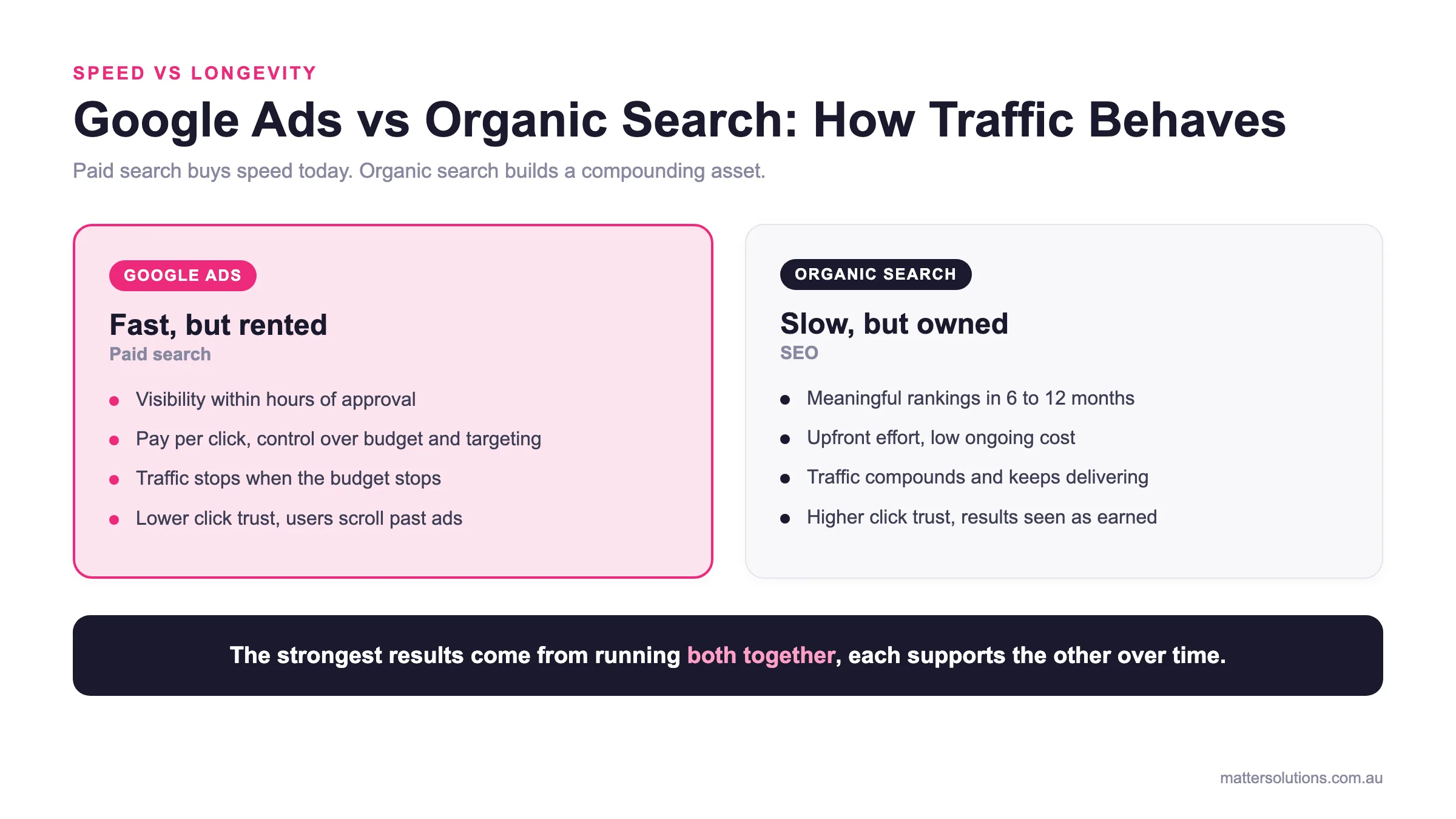
Speed vs longevity
Google Ads vs Organic Search: How Traffic Behaves
Paid search buys speed today. Organic search builds a compounding asset.
Fast, but rented
Paid search
- Visibility within hours of approval
- Pay per click, control over budget and targeting
- Traffic stops when the budget stops
- Lower click trust, users scroll past ads
Slow, but owned
SEO
- Meaningful rankings in 6 to 12 months
- Upfront effort, low ongoing cost
- Traffic compounds and keeps delivering
- Higher click trust, results seen as earned
The strongest results come from running both together, each supports the other over time.
Google Ads buys speed today, organic search builds a compounding asset, and running both together gives the strongest result.
Google Ads or Organic Search: Here’s How to Choose
Most businesses assume one method cancels out the other, but it doesn’t. The right call depends on where your business stands right now, what your timeline looks like, and how much your budget can stretch.
Here is how to read those signals clearly.
Signs Your Business Should Start With Google Ads
Some situations call for speed above everything else. For instance, a new business may have little to no organic search presence and need visibility quickly. The same applies to campaigns targeting specific demographics in highly competitive markets.
In situations like these, Google Ads often makes sense because campaigns can start driving visibility and clicks as soon as they go live.
Ultimately, paid search puts your business in front of potential customers fast, and the advanced targeting options mean your ads reach the right target users at the right moment. Beyond that, the detailed analytics Google Ads provides give you real data on what search intent your audience has (that information alone is worth the initial investment for many businesses).
When Organic Search Makes More Strategic Sense
For businesses focused on building steady, long-term traffic and reducing reliance on ad spend, organic SEO is often the more strategic path. Sustainable growth through organic search builds over time. Not to mention, once you’re ranking on Google search results, the ongoing cost drops significantly compared to maintaining paid search campaigns.
Besides that, a well-executed SEO strategy compounds gradually. For example, high-quality content, strong organic strategies, and consistent SEO efforts push your website’s visibility higher across search engines without the pressure of an ongoing ad spend.
Stop Guessing and Start Growing: Here’s Your Next Move
Now that you understand how Google Ads and organic search work, the next step is deciding where your budget goes. At the end of the day, both channels serve different purposes, and careful consideration of your timeline, business objectives, and budget will point you in the right direction.
Google Ads might get you in front of potential customers fast, but organic search builds a cost-effective, sustainable foundation for your business’s online presence over time. The strongest results come from using both together, as each supports and improves the other over time.
If you are ready to build a digital marketing strategy that pulls from both channels, Matter Solutions can help you get there. Our team works on SEO, Google Ads, and content strategy to improve visibility and drive qualified traffic. Visit our website for more information.
Frequently Asked Questions about Google Ads and Organic Search
Businesses weighing up Google Ads against organic search tend to run into the same questions. We’ve pulled together the most common ones below. If yours isn’t listed, get in touch, and we’ll talk it through.
Does Running Google Ads Improve Your Organic Search Rankings?
No. Google maintains a strict separation between paid search and organic results. Therefore, running ads does not boost your organic rankings, though the data from ad campaigns can inform your organic SEO strategy over time.
How Much Should a Small Business Budget for Google Ads?
There is no fixed answer, but most small businesses start with a daily budget between $20 and $50. As competitive keywords in some industries push costs higher, starting small and scaling based on performance is usually the better move.
Can You Run Google Ads and Organic SEO at the Same Time?
Yes, and frankly, most businesses should. Running both channels together means your paid ads drive immediate traffic while your organic strategies build sustainable growth in the background. The two methods complement each other well.
Does Organic SEO Still Work With So Many Ads on Google?
It does. Organic listings still capture a significant share of clicks, particularly from users who scroll past paid advertisements. Strong content quality and relevant queries remain the foundation of any solid long-term SEO strategy, after all.
What Are the Key Differences Between Paid and Organic Search?
Paid search delivers immediate visibility at an ongoing cost, while organic search builds sustainable traffic over time through site speed, content, and keyword research. Ads vs organic comes down to speed versus longevity, and ideally, you invest in both.
Need help with your digital marketing?
Book a free strategy call and let's discuss your goals.
Book a Strategy Call