Every time a site drops in Google ranking, the first instinct is to check content or backlinks (rarely does anyone look deeper). But some of the major ranking losses come from technical issues hiding inside the site. And search engines often encounter these problems before they read a single word.
A technical SEO site audit helps you uncover those issues. It shows what search algorithms see when they crawl your site, including site speed problems, broken structures, and indexation gaps that often affect visibility. As a result, you can prioritise the fixes most likely to improve rankings and organic traffic.
In this guide, you’ll go through the steps in the technical SEO auditing, crawl setup, on-page fixes, and everything in between. Read on, and by the end you’ll know exactly where your site stands.
Technical SEO Site Audit: What It Actually Covers
A technical SEO audit is a structured review of how search engines access, crawl, and index your site. It also examines the technical foundation beneath your content (the part most site owners never see, but search bots evaluate first).
If your rankings have plateaued with no clear reason, a technical audit often uncovers the cause. In many cases, visibility issues stem from technical problems that prevent search spiders from properly understanding or accessing your website.
To identify those problems, a comprehensive SEO audit reviews site structure, broken links, meta tags, duplicate content, and internal links. Each of these elements influences how Google process your pages and whether they appear in search results. So technical issues at this level hurt user experience and search engine optimisation performance before a single visitor ever lands on your site.
In short, a technical SEO assessment is a full health check for your site. It tells you what search engines see, what they can read, and what technical issues are quietly costing you rankings.
Technical SEO audit
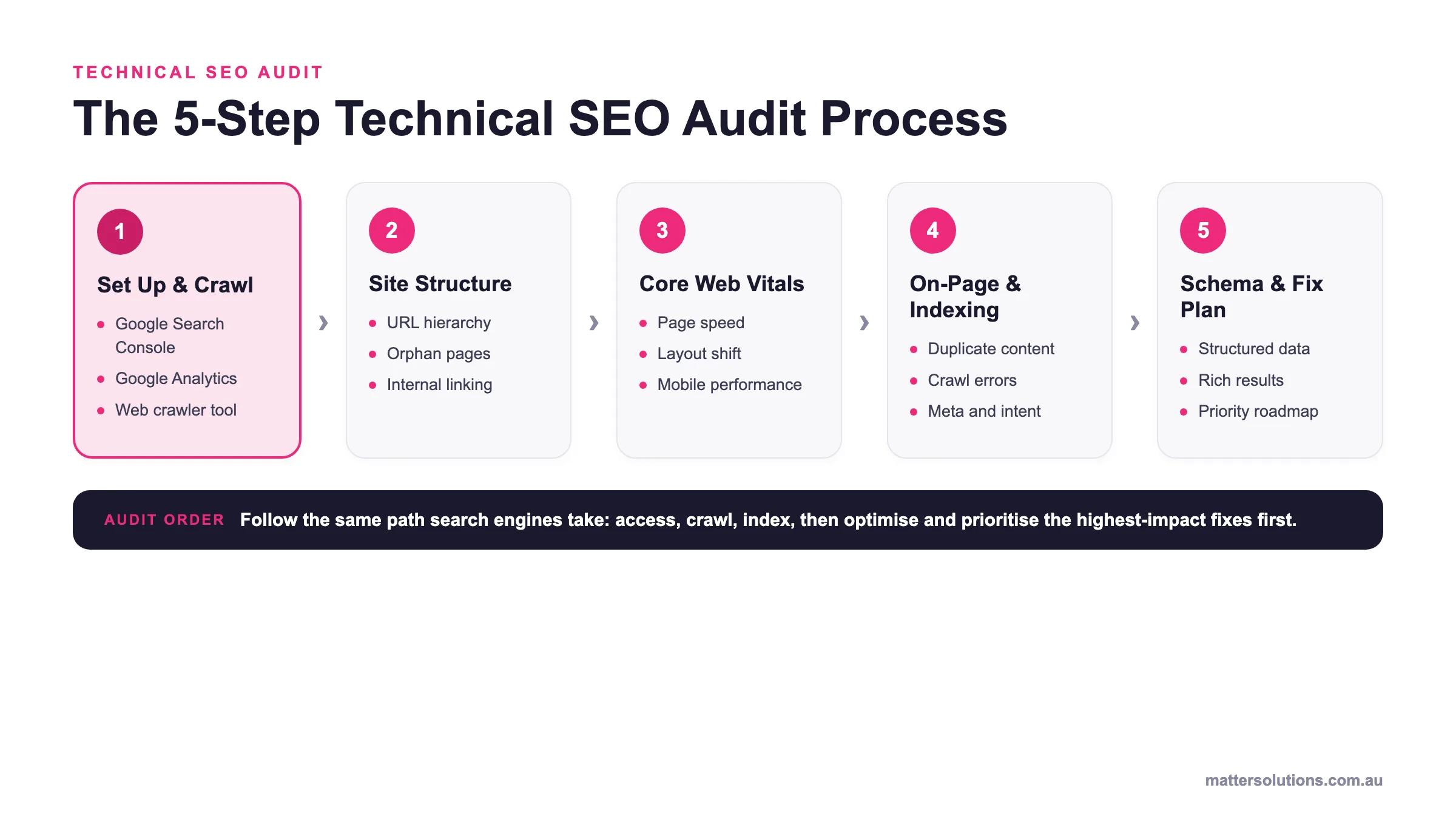
The 5-Step Technical SEO Audit Process
Set Up & Crawl
- Google Search Console
- Google Analytics
- Web crawler tool
Site Structure
- URL hierarchy
- Orphan pages
- Internal linking
Core Web Vitals
- Page speed
- Layout shift
- Mobile performance
On-Page & Indexing
- Duplicate content
- Crawl errors
- Meta and intent
Schema & Fix Plan
- Structured data
- Rich results
- Priority roadmap
Audit order: follow the same path search engines take: access, crawl, index, then optimise and prioritise the highest-impact fixes first.
The five-step technical SEO audit process, in the same order search engines access, crawl, and index a site.
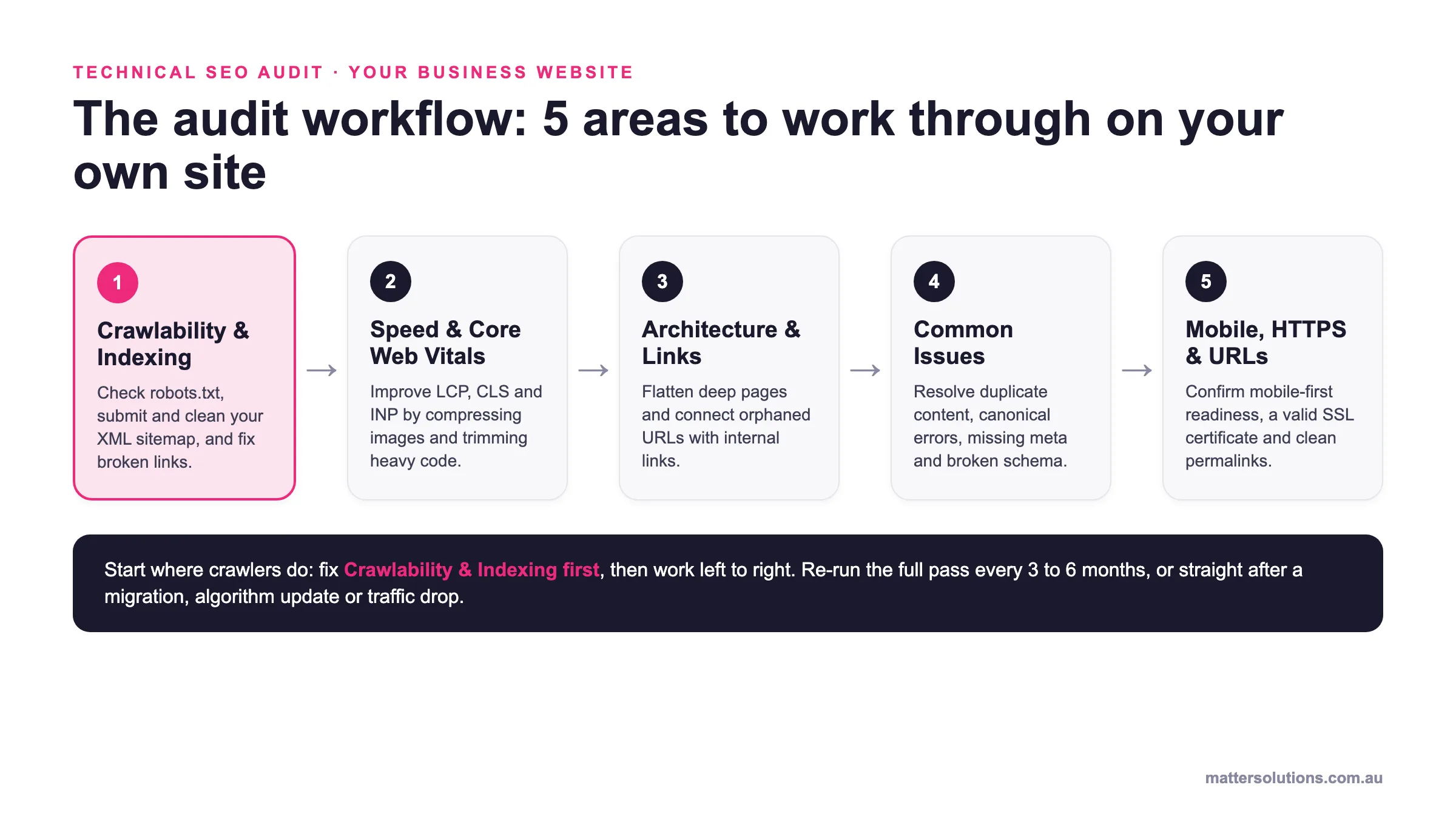
Steps in Technical SEO Auditing: How to Work Through the Process
A technical SEO audit on your own site needs a clear order. Otherwise, you’ll end up fixing surface issues while deeper problems continue affecting search performance.
In practice, you can start the audit with setup, then review site architecture, and finally analyse crawl data. As web crawlers evaluate websites in a similar sequence, your audit should follow that same order.
The following three areas set the foundation for everything else in a technical audit.
Choosing the Right Site Audit Tools for Your Setup
You don’t need ten platforms to run a proper technical SEO review. The following three tools do most of the work.
- Google Search Console: It shows how your site appears in Google searches and flags indexing errors directly in your dashboard. The platform also provides first-hand data from Google, which makes it one of the best starting points for any technical SEO audit.
- Google Analytics: Connect Google Analytics with Google Search Console data. That combination identifies which technical issues affect real traffic rather than just appearing in reports. Drawing from our experience, the two tools often reveal problems that remain hidden when you view them separately.
- Web Crawler: To complete the picture, use a web crawler or dedicated crawl tool. These tools show your site from a search engine’s perspective and uncover technical issues at scale.
Get these three tools connected before your audit begins because the data they surface influence every decision from that point forward.
Site Architecture: Reading How Your Pages Connect
Site architecture determines how Google discovers and moves through pages across your site. So a poorly connected site here means search engine crawlers burn through their budget on the wrong pages.
One common result of that poor site architecture is orphan pages. Crawlers often miss these pages because they have no internal links, which limits their visibility in search results. Based on our firsthand experience, fixing them can produce ranking improvements faster than many on-page changes.
A stronger internal linking structure can fix that problem and keep all the important pages visible and accessible. It also signals to search engines which pages carry the most weight across your site.
How Search Engines Crawl and Index Your Content
Your robots.txt file controls which pages search bots can access and crawl (it’s often the most misconfigured file on a website). If you mistakenly add a single incorrect directive here, it’ll block important pages and prevent search algorithms from indexing your content.
After accessing your pages, search engines need guidance on where to go next. Generally, an XML sitemap points search bots to your most relevant pages for faster, more accurate indexation. For larger sites, a sitemap index file manages multiple sitemaps without confusing Google or splitting crawl priority.
Even with a proper sitemap, crawlers still operate within a fixed crawl budget. As a result, they may never reach pages buried too deep in your site structure, regardless of how good the content is.
Site Structure and the Pages That Drive Your Rankings
Poor site structure is one of the most overlooked reasons pages fail to rank. Because when search engines struggle to navigate your website efficiently, they often spend valuable crawl resources on less important pages. Therefore, high-value pages can miss out on the visibility they deserve.
That’s why the structural areas below are worth auditing in any technical SEO site audit:
- URL Structure and Page Hierarchy: Your URL structure tells search engines and users where a page sits within your site before they read a single word. That means messy or inconsistent URLs confuse crawlers and dilute link signals across the site.
- Orphan Pages and Crawl Gaps: During site redesigns, orphan pages often lose the internal links that connect them to the rest of the website. As a result, search engine bots struggle to find them during a crawl. For that reason, run a crawl after any redesign and check for pages with zero internal links pointing to them.
- Internal and External Links: Strong internal and external links signal relevance directly to search algorithms, which supports search rankings. So pages without either type of link rarely rank well since search algorithms have no clear way to assess their importance.
- Mobile Devices and Page Depth: If you bury your pages within a poor structure, search engines will take longer to discover and evaluate them. Because Google generally factors in accessibility when deciding which pages rank and which don’t.
- Site Health and Fix Priorities: A site health review helps you identify pages with weak link equity, broken URL structure, or missing external links. And addressing the highest-impact issues first helps your key pages regain organic presence sooner.
Quick Tip: Identify pages with no internal connections and broken URL structure. Those are your first fixes in any serious SEO audit because crawlers can’t rank pages they don’t reach or understand.
After you map the site structure, focus on the performance signals that affect search performance.
Core Web Vitals: Performance Signals You Can’t Afford to Miss
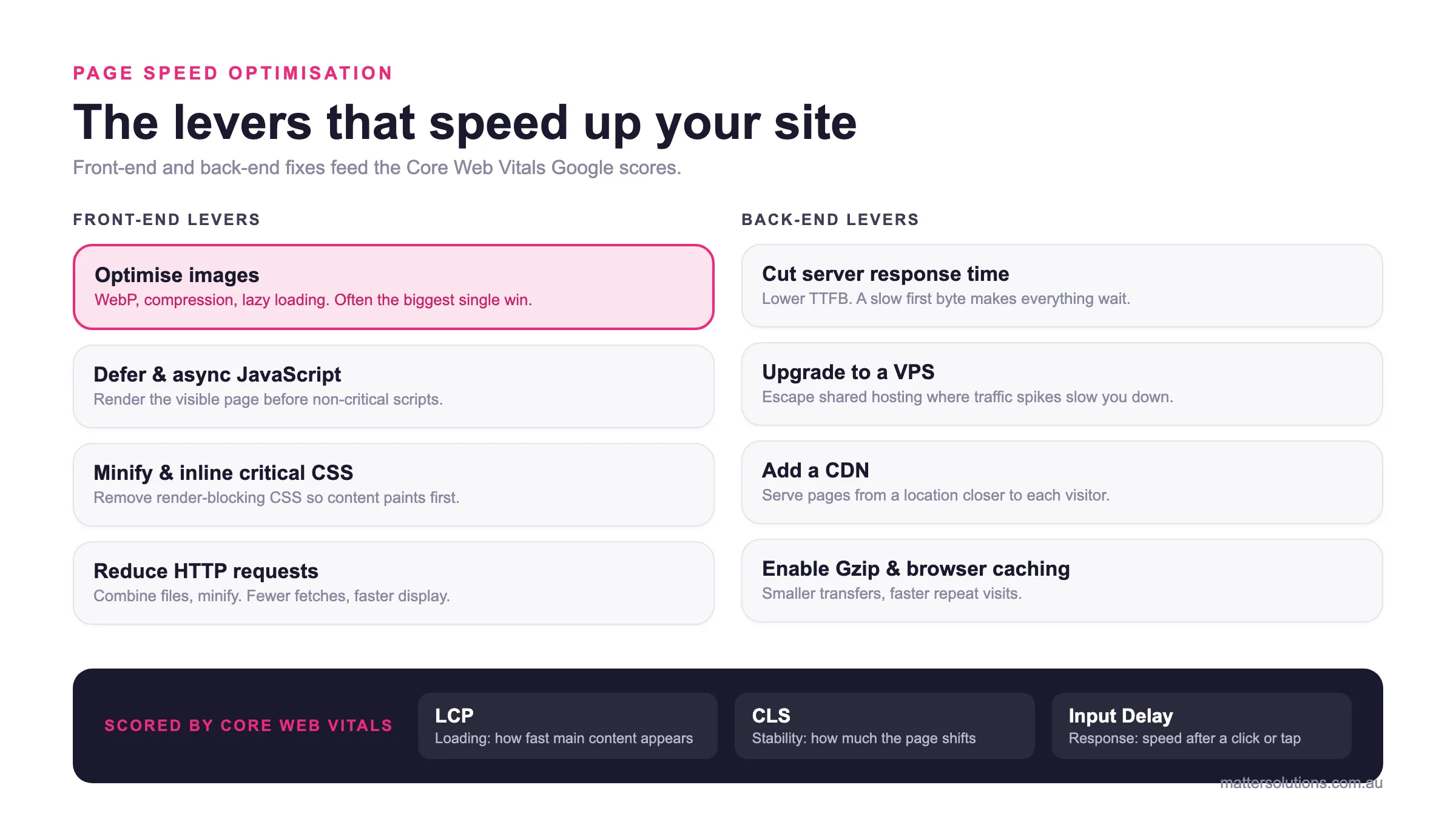
Generally, Core Web Vitals focus on three areas: site speed, visual stability, and interactivity. Together, these metrics tell search bots how real users experience your web pages on both desktop and mobile devices. Google also uses them as ranking factors, which makes them an important part of any technical SEO audit.
Once you start measuring those metrics, problem areas often become obvious. Among those problems, slow page speed and cumulative layout shift can quickly hurt search visibility. In practice, slow pages drive visitors away before they engage with your content, while layout shifts make pages harder to use by moving elements unexpectedly as they load.
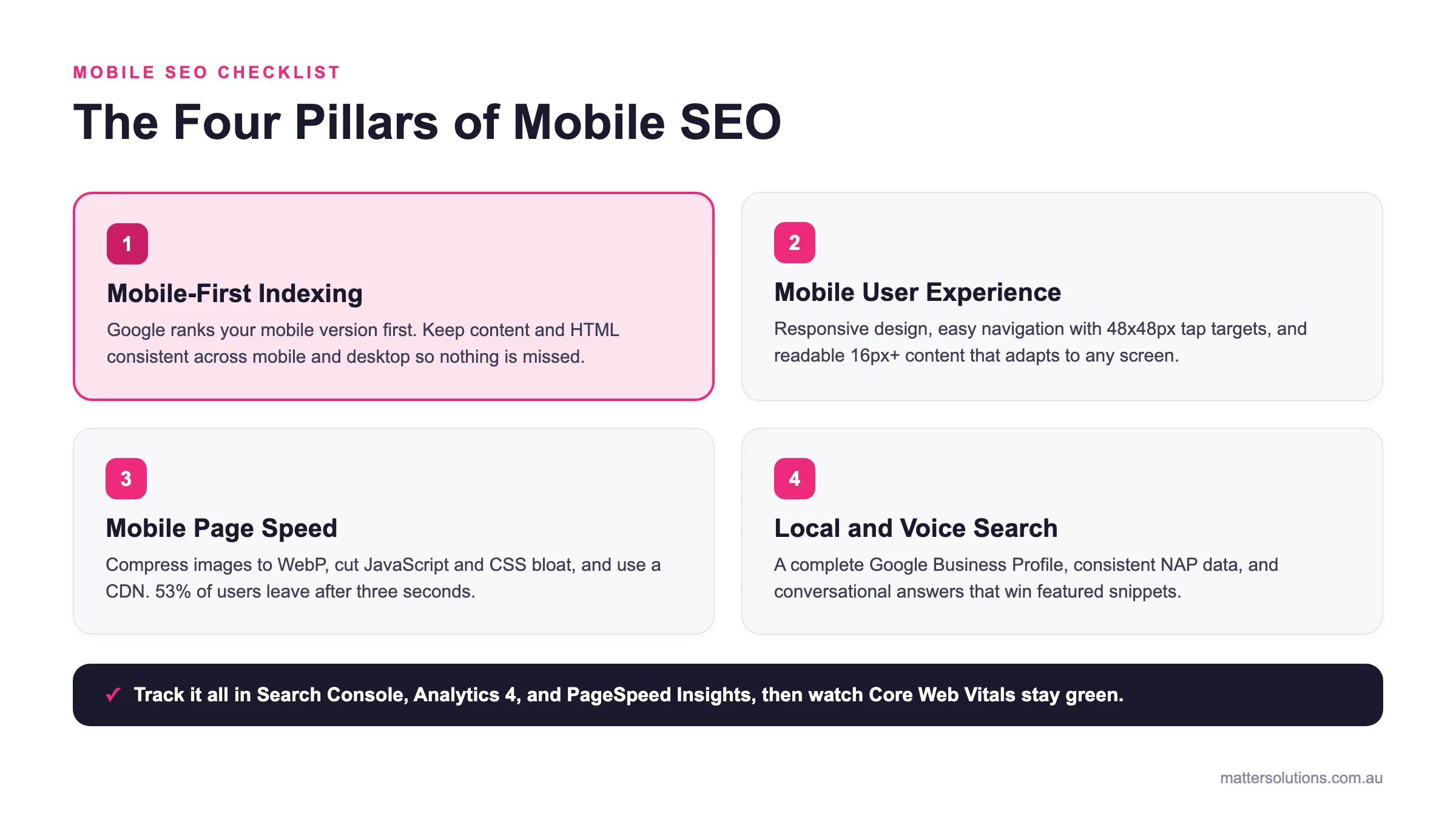
These issues become even more noticeable on mobile devices because users expect pages to load quickly and respond without delays. For that reason, optimising your mobile version often improves overall site performance. And if your site receives heavy traffic from mobile users, a content delivery network (CDN) can reduce load times significantly.
The good news is that you can monitor all of these signals in one place. Google Search Console reports page speed, cumulative layout shift, and other Core Web Vitals metrics directly in your dashboard. So review those reports regularly and prioritise the pages showing the largest performance gaps.
On-Page Optimisation: The Audit Steps That Fix Real Problems
On-page optimisation covers title tags, meta descriptions, headings, internal links, image alt text, and page content. These elements help search engines understand, index, and rank your pages.
With a thorough review, you can identify issues in those elements that prevent important pages from appearing for the right searches.
The three areas below cover the on-page fixes most sites need after completing a technical SEO audit.
Hunting Down Duplicate Pages Before They Hurt Rankings
Duplicate content confuses Google bots about which page version should appear in search results. To be more specific, when two pages contain the same information, they split ranking signals and reduce the visibility of both versions.
These duplicate pages often come from URL parameters, printer-friendly versions, or staging content that teams forget to block from indexation. And you can identify such issues quickly by running a crawl and comparing the results with Google Search Console.
To prevent duplicate URLs, canonical tags help you control which version search engines should treat as the primary page. They consolidate ranking factors into a single URL and prevent duplication issues from spreading over time.
Getting All the Important Pages Indexed Properly
Basically, crawl errors inside Google Search Console reveal which important pages crawlers can’t access. Prioritise those issues first because pages that never enter the index cannot rank, regardless of content quality.
Next, block admin pages and staging content in your robots.txt file to protect crawl budget on larger sites. Based on our firsthand experience, repeatedly sending crawlers to low-value pages can delay the indexation of more important pages.
At the same time, use a clean XML sitemap to help search engines discover important pages more efficiently. So cross-check your sitemap against Search Console regularly to identify gaps before they affect visibility.
Writing for Search Intent, Not Just Search Engines
Search intent usually reflects what users genuinely want when they run specific search queries through Google. If you get this wrong, your pages will attract the wrong audience and struggle to convert visitors.
Your meta description is often the first indication that a page matches a specific intent. Because of this, meta descriptions should match the relevant content of your page and align with what users expect from search results. In fact, treat meta tags as your first pitch to a searcher rather than an afterthought.
What’s more? On-page content that matches search intent tends to earn higher click-through rates and keep users on the landing pages longer. Search engines also read such behaviour as a positive signal, which feeds back into rankings over time.
Schema Markup and Its Place in a Solid SEO Strategy
Search engines understand your pages better when you add structured data. Otherwise, they view your content as plain text with little information about what it represents (and most CMS platforms don’t add this automatically).
Schema markup fills that gap by giving search spiders clear information about your page. As a result, Google can easily interpret your pages and display them accurately in search results. It means schema markup can improve search visibility without requiring any changes to the page itself.
Now, let’s see what structured data actually does for your technical SEO performance:
- Rich Results and Organic Traffic: Stronger structured data improves search engine visibility and drives organic traffic by earning rich results in Google searches. Because rich results outperform standard listings as they often attract higher click-through rates.
- Matching Pages to Search Intent: Pairing relevant content with the right schema markup helps search algorithms match your pages to the right search intent. This approach directly supports search engine rankings for specific queries.
- Your Broader SEO Strategy: Beyond individual pages, schema markup reinforces your overall SEO strategy by giving b a consistent, reliable signal about every page. Internet users and search engines both benefit from that clarity.
- Meta Descriptions and Structured Data: Accurate meta descriptions alongside structured data give crawlers two aligned signals about your related content. Together, they improve how search engines view your pages across all Google searches.
Bottom Line: Schema markup is a long-term investment in how search algorithms read and present your content. So you should add it to every priority page and treat it as a permanent part of your technical SEO checklist.
Your SEO Audit Findings: Building a Fix Priority Plan
Once you complete a site audit, you’ll often uncover more issues than you can fix at once. Therefore, instead of tackling everything without a clear order, use the findings to build a priority plan. This approach helps you focus on the fixes with the greatest impact on search performance.
Here’s a simple framework for prioritising your SEO audit findings in order of impact:
| Priority | Fix Type | Focus Area |
| 1 | Technical Issues | Crawl errors, broken links, robots.txt file |
| 2 | Indexation | XML sitemap, important pages, admin pages |
| 3 | On Page | Meta tags, search intent, internal links |
| 4 | Performance | Site speed, core web vitals, mobile pages |
| 5 | Authority | External links, organic traffic, keyword research |
Always start with technical issues because crawl errors and broken links can stop search engines from reaching the pages you want to rank.
From there, shift your attention to on-page improvements and review pages with weak search-intent alignment, missing meta tags, and poor internal linking. A clear SEO audit action plan maps each of these fixes to specific pages so nothing overlaps and no effort goes to the wrong place.
After implementing those changes, run a manual search in Google Search Console to ensure that Google is indexing the updated pages properly. Based on our experience, teams that track performance after each fix identify problems sooner and recover rankings more consistently.
Finally, monitor organic traffic and external links regularly. As search results change constantly, reviewing performance data helps you spot new issues early before they undo your performance gains.
Your Technical SEO Audit Checklist Is Only the Beginning
A comprehensive SEO audit tells you exactly where your site stands with search engines. It surfaces broken links, crawl errors, site speed issues, and indexation gaps, which pull your Google search performance down. And none of those problems fixes themselves.
Work through each issue in order. Start with technical fixes, move to on-page updates, then improve search visibility with schema markup and structured data. This sequence helps a site audit lead to ranking gains instead of sitting unused in a spreadsheet.
When you’re ready to run a technical SEO site audit with an experienced team, Matter Solutions is here to help. We have been working with businesses across Australia since 2000, and we know what search engines want to see.
Book a free strategy call today, and we’ll review your site together.
Frequently Asked Questions About Technical SEO Audits
Here are quick answers to the questions business owners ask most before running a technical SEO audit.
What does a technical SEO audit actually check on my website?
A technical SEO audit checks how search engines access, crawl and index your site. It reviews site structure, broken links, meta tags, duplicate content and internal links, along with site speed and indexation gaps. Think of it as a full health check that shows what search engines see and which technical issues are quietly costing you rankings.
What tools do I need to run a technical SEO audit myself?
You need three tools to run a proper technical SEO audit: Google Search Console, Google Analytics and a web crawler. Search Console flags indexing errors with first-hand data from Google, Analytics shows which issues affect real traffic, and a crawler reveals your site from a search engine’s perspective. Connect all three before you begin, because their data shapes every decision that follows.
Which technical SEO issues should I fix first after an audit?
Fix technical issues first: crawl errors, broken links and robots.txt problems, because they can stop search engines reaching the pages you want to rank. From there, work through indexation and your XML sitemap, then on-page elements like meta tags and internal links, and finish with site speed, Core Web Vitals and authority signals.
Need help with your digital marketing?
Book a free strategy call and let's discuss your goals.
Book a Strategy Call